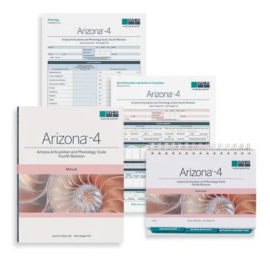
Provides a quick, reliable, and well-standardized measure of articulation and phonology to help clinicians identify individuals who need speech sound services
Standardized on a nationally representative sample of 3,192 children, adolescents, and young adults
The individual names, repeats, or reads stimulus content, and the examiner notes articulatory and phonological errors.
What’s New in the Arizona-4
- Three tests in one assessment: Word Articulation, Sentence Articulation, and Phonology
- All-new normative data
- Extension of the standardized age range to 21 years, 11 months, with guidance for describing and understanding the speech of adults of all ages
- Modified scoring system for more effective identification of individuals with speech sound disorders
- Five optional tasks that inform treatment plan development
- Scoring guidance for dialectal variations
- Full-color illustrations that are more engaging for young children
- Digital stimulus images
- FREE online scoring and report generation through the WPS® Online Evaluation System™
Overview
The Arizona-4 measures speech intelligibility, articulatory impairment, and phonological impairment in one easy-to-use assessment. It features enhancements that add to its effectiveness in identifying individuals who have speech sound disorders. New norms, refined measurement properties, and the addition of connected-speech and phonology tests help clinicians identify individuals who may benefit from speech sound services. Supplemental qualitative tasks facilitate deeper interpretation of the scores and help clinicians develop treatment plans targeted to the individual’s needs.
Applications and Uses
The Arizona-4 can be used by speech and language professionals in a variety of settings, including schools, clinics, hospitals, private practices, and intervention programs. Its applications include:
- Understanding and describing an individual’s level of articulatory ability and overall speech intelligibility in both single-word and connected speech
- Comparing single-word and connected-speech articulatory abilities
- Determining the extent to which phonological impairment may contribute to an individual’s articulatory deficits, and describing the specific types of phonological error patterns that are displayed
- Facilitating early identification of speech sound development concerns and determining whether an individual may benefit from treatment services
- Identifying and prioritizing speech targets for individualized intervention through analysis of the examinee’s specific articulatory/phonological deficits and relative strengths, including the production of consonants, consonant blends, vowels, and vocalic /r/
- Monitoring improvement in an individual’s speech sound production over time
- Evaluating the degree of consistency in an individual’s production of misarticulated sounds, the impact of speech sound deficits in continuous language and everyday speech, and the need for further language assessment or intervention
What It Measures
The Arizona-4 scores help clinicians to identify individuals who need speech sound services and to develop treatment plans for them. The primary score is the easy-to-understand Word or Sentence Articulation Total Score, which has a direct interpretation. Research using Total Scores links these scores to the rate of speech sound occurrence in American speech. This research expresses how often misarticulated sounds occur in everyday speech and their impact on speech intelligibility. The Word–Sentence Articulation Critical Difference Score provides further information about clinically meaningful differences between articulation in single-word versus connected-speech contexts.
Standard scores for Word Articulation, Sentence Articulation, and Phonology compare examinee performance with the performance of a typically developing peer group based on age (and gender, for younger ages). Severity ranges, confidence intervals, percentile ranks, and test-age equivalent scores further aid clinical interpretation. The Arizona-4 scores use easily understood descriptive language for parents and other nonprofessionals.
Expanded guidelines for interpretation cover topics of extreme scores, item-level analysis, percentage of occurrence of phonological error patterns, and use of the Arizona-4 to measure change over time. Additional qualitative information is available through various supplemental, nonstandardized tasks that help clinicians plan effective treatment for the individual.
The Arizona-4 offers the following scores:
- Total Scores and associated Speech Intelligibility Interpretation Values
- Standard Scores and associated severity ranges for the level of articulatory and phonological impairment
- Word–Sentence Articulation Critical Difference Score
- Percentage of Occurrence for phonological error patterns
- Percentage of Speech Improvement Score for retesting
How It Works
The Word Articulation and Sentence Articulation tests of the Arizona-4 are administered to the examinee and may be used singly or in combination, as needed. The Phonology test is coded by the clinician based on the examinee’s speech productions during Word Articulation.
Word Articulation may be administered using the Test Easel or the Digital Stimulus Images With Administration Guide. The clinician presents the stimulus content to the examinee, and the examinee names the depicted word or repeats it after the clinician; older examinees may read the words. The clinician records the examinee’s production of the target sounds on the Word and Sentence Articulation Record Form, and the clinician may choose to code these productions for 11 phonology error patterns on the Phonology Coding Form.
The target sounds in Word Articulation can be tested at the sentence level by administering Sentence Articulation using the Test Easel or the Digital Stimulus Images With Administration Guide. In Sentence Articulation, the single words from Word Articulation are embedded in brief, simple sentences that are spoken by the examinee (the examinee can read the sentences or repeat them after the clinician; sentences are written at a first-grade reading level). Direct comparisons can be drawn between the examinee’s productions of the Arizona-4 target sounds at the word and sentence levels.
After the clinician has administered the relevant articulation tests and coded for phonology as needed, the clinician can use the WPS Online Evaluation System for free online scoring and report generation. The clinician can also score manually.
FREE Online Scoring and Reporting
Upon purchase of an Arizona-4 Kit or Forms, you gain access to digital scoring through the WPS Online Evaluation System at no additional charge! This gives clinicians the option to score online and automatically generate the Score Report, including Item Discrepancy Analysis. Time saving and HIPAA compliant, WPS’s online testing platform securely and conveniently keeps a record of the clinician’s administrations and shares helpful information with parents, teachers, and others involved in treatment.
Components and Formats:
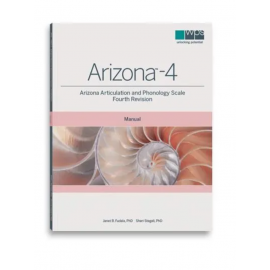
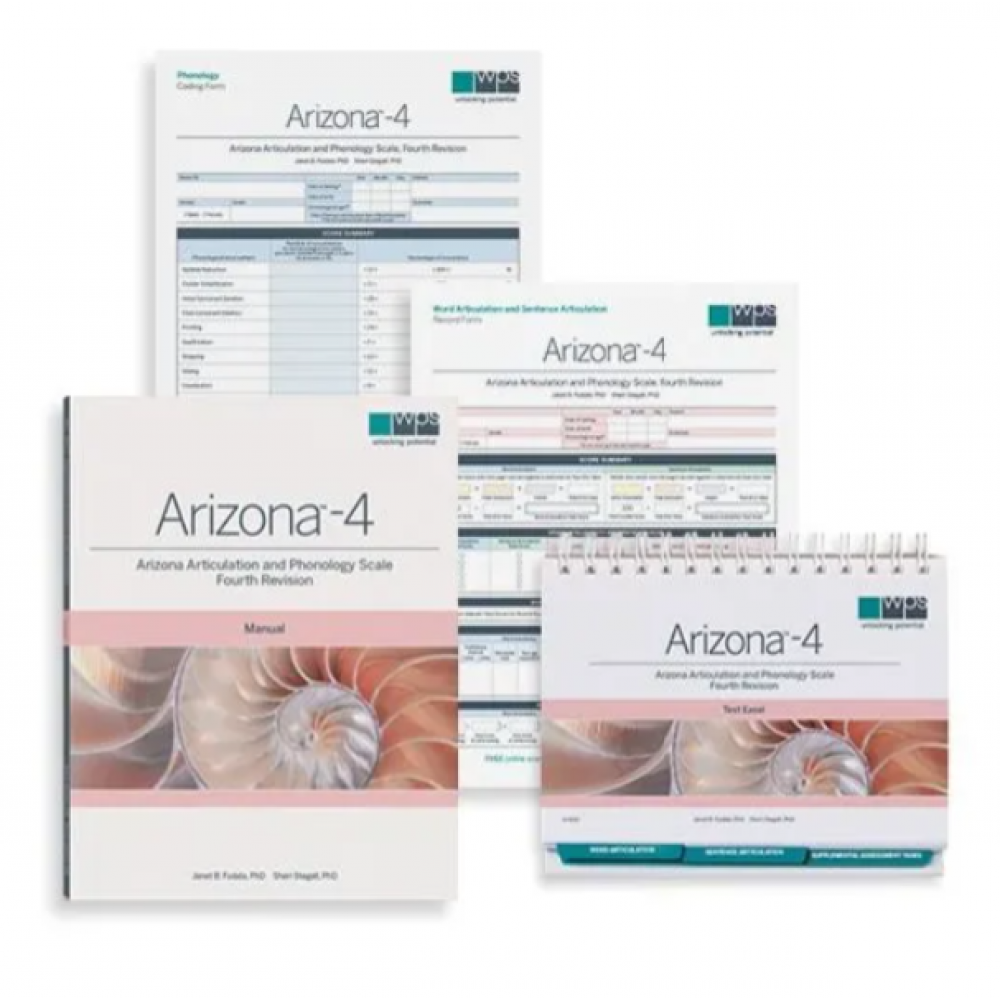
Manual
The Manual contains detailed information on the administration, scoring, interpretation, development, standardization, and psychometric properties of the Arizona-4.
Format: Online; Print
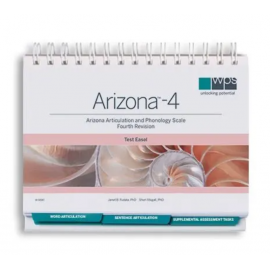
Test Easel
A self-standing stimulus book that includes all materials required to administer the Arizona-4, such as instructions, examples, pictures, test items, prompts, scoring criteria, skill descriptions for each item, and selected Supplemental Assessment Tasks. Sections are clearly tabbed for quick reference during administration.
Format: Print
Digital Stimulus Images with Administration Guide
The electronic version of the Test Easel includes digital stimulus images and a Digital Administration Guide for use online or offline. A Print Administration Guide is also included for added convenience.
Format: Online; Digital
Word Articulation and Sentence Articulation Record Form
An 8-page booklet used to administer and score Word Articulation and Sentence Articulation, as well as to support Supplemental Assessment Tasks. This form must be used during test administration. Scoring can be completed manually or automatically through the WPS Online Evaluation System.
Format: Print with Online Scoring
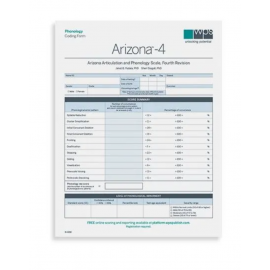
Phonology Coding Form
A 4-page booklet used to code and score phonology following the Word Articulation assessment. It is required for identifying phonological error patterns. Scoring may be completed manually or automatically through the WPS Online Evaluation System.
Format: Print with Online Scoring
Reliability and Validity
The Arizona-4 was standardized on a nationally representative sample of 3,192 children, adolescents, and young adults, aged 1 year, 6 months–21 years, 11 months. This sample was stratified to match U.S. Census data for gender, race/ethnicity, parents’ educational level, and geographic region. A clinical validation sample was also collected; the sample consisted of 50 individuals who had a speech sound disorder diagnosis (articulation and/or phonological disorder) and who were receiving treatment services.
The Arizona-4 has strong internal consistency, test–retest reliability, and interrater reliability, supporting the stability of Arizona-4 results within tests, over time, and across examiners.
Several studies provide valid evidence supporting the Arizona-4. The Arizona-4 scores show the expected progression of development for speech sound mastery and the expected age for specific target sounds and phonological error patterns, providing evidence of adequately captured speech sound development. Validity evidence also includes correlations with other established measures of articulation and phonology. A clinical study supports the ability of the Arizona-4 to distinguish those with clinically diagnosed speech sound disorders from those who do not. These results are indicative of sensitivity and specificity, as well as positive and negative predictive value, for the Arizona-4 tests.
效益
提供快速、可靠且具良好標準化的構音與音韻評估,協助臨床人員辨識需要語音服務的個體
常模
以 3,192 名兒童、青少年與年輕成人的全國代表性樣本建立標準化資料
形式
受測者進行命名、重複或朗讀刺激內容,施測者記錄其構音與音韻錯誤
施測時間
5–20 分鐘
適用年齡
18 個月至 21 歲 11 個月
出版年份
2017
使用資格
需具備 C 級資格
Arizona-4 的新特色
- 一套評估包含三種測驗:詞語構音、句子構音與音韻
- 全新常模資料
- 標準化年齡延伸至 21 歲 11 個月,並提供成人語音描述指引
- 改良計分系統,更有效辨識語音障礙
- 五項選用任務,協助制定治療計畫
- 提供方言差異的計分指引
- 全彩圖像,更吸引幼兒
- 數位刺激圖片
- 透過 WPS® 線上系統提供免費計分與報告產生功能
概述
Arizona-4 為一套簡便易用的評估工具,可同時測量:
透過新常模、優化測量特性,以及新增連續語音與音韻測驗,有助於更精確辨識需要語音治療的個體。
此外,輔助性的質性任務能協助更深入解讀結果,並制定個別化治療計畫。
應用與用途
Arizona-4 可應用於多種場域:學校、診所、醫院、私人執業與介入服務機構等。
用途包括:
- 評估單詞與連續語音中的構音能力與語音清晰度
- 比較單詞與句子層級的構音表現
- 判定音韻障礙對構音問題的影響
- 早期識別語音發展問題
- 制定個別化治療目標(如子音、母音、子音群等)
- 追蹤語音改善進展
- 評估錯誤發音的一致性與日常溝通影響
測量內容
Arizona-4 提供多種分數,協助臨床判斷:
- 詞語/句子構音總分(主要指標)
- 語音清晰度解釋值
- 構音與音韻障礙的標準分數與嚴重程度範圍
- 詞語與句子構音差異分數
- 音韻錯誤模式出現比例
- 重測語音進步百分比
分數設計易於理解,適合家長及非專業人士使用。
施測方式
- 可單獨或合併施測「詞語構音」與「句子構音」
- 「音韻測驗」依據詞語構音表現進行編碼
施測流程:
- 使用圖卡或數位圖片呈現刺激
- 受測者命名、重複或朗讀
- 施測者記錄發音並進行分析
- 可比較單詞與句子表現差異
完成後可:
免費線上計分與報告
購買 Arizona-4 套件後,可免費使用 WPS 線上系統:
- 自動產生報告(含題項差異分析)
- 安全儲存資料(符合 HIPAA)
- 方便與家長、教師分享
信度與效度
- 樣本符合美國人口統計(性別、族群、教育、地區)
- 具高度內部一致性、重測信度與評分者一致性
- 能有效區分有無語音障礙個體
- 與其他測驗具良好相關性
顯示 Arizona-4 在臨床評估上具高度信度與效度。