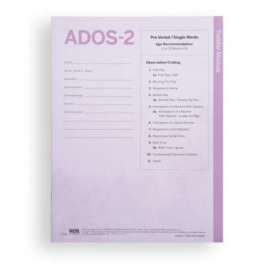
Allows you to accurately assess and diagnose autism spectrum disorders (ASDs) across age, developmental level, and language skills
Safety Warning: Small parts may pose a choking hazard for children under 3 years.
From the World's Leading Autism Experts
This revision improves an instrument already viewed as the gold standard for the observational assessment of autism spectrum disorders (ASDs). With updated protocols, revised algorithms, a new Comparison Score, and a new Toddler Module, the ADOS-2 provides a highly accurate picture of current symptoms unaffected by language. The ADOS-2 can be used to evaluate almost anyone suspected of having ASD—from 1-year-olds who do not consistently use phrase speech to adults who are verbally fluent.
Like its predecessor, the ADOS-2 is a semi-structured, standardized assessment of communication, social interaction, play, and restricted and repetitive behaviors. By observing and coding these behaviors, clinicians can obtain information that informs diagnosis, intervention, treatment planning, and educational placement.
Five Modules
The ADOS-2 contains five modules, each requiring just 40–60 minutes to administer. The individual being evaluated is given only one module, selected based on their expressive language level and chronological age.
Toddler Module—for children between 12 and 30 months of age who do not consistently use phrase speech
- Module 1—for children 31 months and older who do not consistently use phrase speech
- Module 2—for children of any age who use phrase speech but are not verbally fluent
- Module 3—for verbally fluent children and young adolescents
- Module 4—for verbally fluent older adolescents and adults
Each module engages the examinee in a series of activities involving interactive stimulus materials, all of which are included in the ADOS-2 Kit. To illustrate, these are the activities in Module 3:
- Construction Task
- Make-Believe Play
- Joint Interactive Play
- Demonstration Task
- Description of a Picture
- Telling a Story From a Book
- Cartoons
- Conversation and Reporting
- Emotions
- Social Difficulties and Annoyance
- Break
- Friends, Relationships, and Marriage
- Loneliness
- Creating a Story
Standardized Administration, Coding, and Scoring
Each ADOS-2 module has its own Protocol Booklet, which structures the administration and guides clinicians through coding and scoring. As the clinician administers activities, they observe the examinee and take notes. Immediately afterward, the clinician codes the behaviors observed. Then the clinician uses the Algorithm Form for scoring.
In Modules 1–4, algorithm scores are compared with cutoff scores to yield one of three classifications: autism, autism spectrum, or non-spectrum. The difference between autism and autism spectrum classifications is one of severity, with the former indicating more pronounced symptoms. In the Toddler Module, algorithms yield “ranges of concern” rather than classification scores.
Improved Protocol Booklets, Revised Algorithms, and a New Comparison Score
Administration and coding procedures for the ADOS-2 are functionally identical to those for the ADOS. Modules 1–4 retain the same basic activities and codes, though some have been expanded and several new codes have been added. Protocol Booklets for these modules have been significantly improved and now provide clearer, more explicit administration and coding instructions.
Algorithms for Modules 1–3 have been revised to achieve more accurate and useful results and to provide a more uniform basis for comparing results across the three modules used with children and young adolescents.
A new Comparison Score for Modules 1–3 allows clinicians to compare a child’s overall level of autism spectrum–related symptoms with the symptoms of children diagnosed with ASD who are the same age and have similar language skills. This score also makes it easier to monitor an individual’s symptoms over time.
The New Toddler Module
The Toddler Module is designed specifically for children between 12 and 30 months of age who do not consistently use phrase speech. Observations are coded immediately following administration, and the codes are converted to algorithm scores. Toddler Module algorithms provide “ranges of concern” rather than classification scores. These ranges help clinicians form clinical impressions, but the ranges avoid formal classification—which may not be appropriate at such a young age. The Toddler Module quantifies risk for ASD and guides further monitoring.
The Most Accurate Picture of Current ASD Symptoms
With improved algorithms, the ADOS-2 demonstrates strong predictive validity. It gives clinicians a highly accurate picture of current ASD-related symptoms based on real-time observations. Physicians, clinical psychologists, school psychologists, speech–language pathologists, and occupational therapists can use ADOS-2 results to inform diagnosis, intervention, educational placement, and treatment planning. Because the ADOS-2 can be used with a wide range of children and adults, it is an essential addition to any hospital, clinic, or school that serves individuals with developmental disorders.
Training Options
ADOS-2 administration and coding are highly standardized. Therefore, valid assessment requires training. A variety of training options are available (all offer opportunities to earn continuing education credits):
ADOS-2 Clinical Workshops
- Live in-person training and live webinars. These 2-day workshops provide instructor-led introductory training on the ADOS-2.
- These workshops are designed for professionals who use the ADOS-2 in clinical practice or research (completion of a Clinical Workshop satisfies the prerequisite requirement for attending advanced research workshops offered through the authors and their colleagues).
- For information about these training options, visit the ADOS-2 Workshop page.
ADOS-2 Training Video Program and ADOS-2 Training Video Upgrade
- Clinicians can use the ADOS-2 Training Video Program (LMS-605) and the ADOS-2 Training Video Upgrade (LMS-606) for online self-study for learning the ADOS-2.
- The ADOS-2 Training Video Program and the ADOS-2 Training Video Upgrade are designed for professionals who use the ADOS-2 in clinical practice (those who plan to use the ADOS-2 in research need to attend live clinical and research workshops).
- The ADOS-2 Training Video Program and the ADOS-2 Training Video Program Upgrade were offered as DVD training packages. The content of the online self-study programs described here is identical to the content of the DVD training packages; only the delivery format has changed. The ADOS-2 DVD Training Package (W-605DVD) has been discontinued and replaced by the ADOS-2 Training Video Program (LMS-605). Limited copies of the PAL format are available in DVD format (W-605DVDP) for overseas customers.
- ADOS-2 Training Video Program (LMS-605):
- This Video Program covers all five modules of the ADOS-2. It has a total running time of about 14 hours.
- It is designed for professionals who are new to the ADOS-2.
- It contains online videos that feature case examples for all ADOS-2 modules. The case examples for Modules 1–4 are identical to those in the original ADOS DVD training package (since these modules retain basic ADOS activities). The case examples for the Toddler Module are new.
- Digital support materials, including the Training Videos Guidebook and Training Protocol Booklets, are for use with the online videos.
- ADOS-2 Training Video Program Upgrade (LMS-606):
- This Video Program covers only the Toddler Module. It has a total running time of about 5 hours.
- It is designed for professionals who have already completed training in Modules 1–4 (via live clinical workshops, the original ADOS DVD training package, or the ADOS-2 Training Video Program [LMS-605]).
- It contains online videos that feature case examples for the Toddler Module.
- Digital support materials, including the Training Videos Guidebook and Training Protocol Booklets, are for use with the online videos. (Note: The portion of the Guidebook covering Modules 1 through 4 can be used only if you have access to the videos from the original ADOS DVD Training Package [W-365DVD]. This upgrade can also be used on its own to provide the training necessary for upgrading skills to use the Toddler Module.)
- If you have videos for Modules 1 through 4 other than the ones from the ADOS DVD Training Package (for example, videos that you may have received by attending an ADOS workshop), those videos are not compatible with this training upgrade package. For five-module video training without access to the original ADOS training videos (W-365DVD), you will need to purchase LMS-605. If you have ADOS training videos but you are unsure whether they will be compatible with this training upgrade package, please contact WPS for clarification.
The ADOS-2 Training Video Program (LMS-605) and the ADOS-2 Training Video Program Upgrade (LMS-606) are available online on the WPS Professional Learning Center (WPS ProLearn).
- To purchase these materials (and the associated continuing education [CE] materials), simply add them to your cart and complete your purchase. You will receive a follow-up email from WPS with information on how to access the materials on the WPS ProLearn.
- For additional CE-related information and products, visit our CE page and CE FAQ page.
Case Examples
Chapters 3 and 7 of the ADOS-2 Manual present case examples for using Modules 1–4 and the Toddler Module. The case examples include a variety of completed ADOS-2 protocols/algorithms and examples of how to include ADOS-2 results in written reports. Cases range from a toddler exhibiting delays in physical development and social communication to an adult experiencing academic and social difficulties in college. Below is an excerpt from the case example for Module 2.
Module 2: “Harry”
Harry is a 6-year-old boy who received a diagnosis of ASD from a statewide early intervention project when he was 2 years old. Harry and his family were recruited to participate in a genetics study of ASD. As part of the study protocol, Harry’s family participated in a research evaluation to confirm Harry’s diagnosis of ASD. Harry’s parents completed a parent interview and several questionnaires. Harry was administered a cognitive test (Differential Ability Scales, Second Edition [DAS-2; Elliot, C. D. (2007). Differential Ability Scales (2nd ed.). San Antonio, TX: Psychological Corporation]) and the ADOS-2.
On the DAS-2, Harry received a Verbal Cluster score of 70 and a Nonverbal Cluster score of 90, indicating Borderline verbal abilities and Average nonverbal abilities. He was observed to use primarily phrase speech. Although Harry often used sentences that included several words, such as “Where are you going, Daddy?” or “I don’t want to go to school,” he did not use complex sentences that included multiple clauses (e.g., “I don’t want to go to school tomorrow because I am too tired”). Module 2 was selected as the appropriate module based on Harry’s expressive language level.
Harry’s mother was present for the administration of Module 2 while Harry’s father met separately with another clinician to complete the parent interview portion of the research evaluation. A description of Harry’s social and communicative behavior during the ADOS-2 is provided in the excerpt from his evaluation report, presented next.
Results
The Autism Diagnostic Observation Schedule, Second Edition (ADOS-2), Module 2 was administered to Harry for diagnostic purposes as part of a research protocol for a study of the genetics of autism. The ADOS-2 is a semi-structured, standardized assessment instrument that includes many play-based activities designed to obtain information in the areas of communication, reciprocal social interactions, and restricted and repetitive behaviors associated with a diagnosis of ASD. Module 2 of the ADOS-2 is designed for children with phrase speech whose speech is not yet “fluent” (that is, who are not yet consistently combining two relatively complex ideas in sentences to talk about objects or events that are not present). Module 2 includes activities such as a construction task, interactive play with a family of dolls, a demonstration task, looking at a book and pictures, a pretend birthday party, bubbles, and a snack.
Harry was excited to transition into the more play-based tasks of the ADOS-2 from the cognitive tests that were administered first. He immediately began exploring the various toys that were set out for him. Harry’s language during the ADOS-2 consisted primarily of short phrases. He said things like, “It’s a cat,” as he was pointing to a picture of a cat on the music box, and “I like more,” and “I like two,” when he was requesting things. Harry sometimes echoed things that other people said, such as “Ooh, nice!” or “Alright.” At times, it was quite easy to understand what Harry was saying, but at other times his articulation made it difficult to understand him. He also occasionally mixed up his pronouns, such as saying, “You do it,” to mean that he wanted to do it. Harry had difficulty participating in conversational exchanges with the examiner. Although he was able to answer simple questions about familiar topics (e.g., How old are you? Do you have any pets?), he did not elaborate on his brief answers or ask questions of the examiner when provided opportunities to do so. This made it difficult to build a conversation with Harry.
Harry sometimes integrated his verbal communication with other modes of nonverbal communication, such as looking at the examiner, smiling, and saying, “Wow,” when he saw something he liked. At other times, he did not use eye contact when talking to people or interacting with them. Harry used a few gestures, such as pretending to brush his teeth when asked to teach this activity to the examiner and blowing a kiss to a baby doll when his mother prompted him to do so. He did not spontaneously use gestures at other times when communicating with the examiner or his mother.
In terms of Harry’s social reciprocity during the ADOS-2, he was sometimes quite interested in interacting with the examiner or his mother. He made a variety of overtures to ask for things and occasionally to express interest or draw attention to something that he was enjoying. Harry had a tendency to be repetitive when initiating interactions with other people, however, such as by saying the same phrase in the same way (e.g., saying “You do it, mommy?” with an exaggerated sing-song intonation to ask for permission). Harry also exhibited a strong interest in University of Michigan football, and he insisted on bringing up things about the football team, even when it was clear that the examiner was trying to change the subject.
While Harry was often responsive to the examiner’s attempts to talk to him or play with him, he showed less interest in social interaction when he was involved in repetitive play activities. At one point, Harry became very interested in putting small objects into a teapot, then dumping them out and starting over again. When the examiner tried to join Harry and put something into the teapot, he stomped and yelled, “No!” and took it out. On another occasion, Harry spent several minutes putting blocks into a box repetitively. He became quite distressed and frustrated when the examiner tried to interrupt him; he flapped his hands while protesting loudly.
Harry exhibited some imaginative play during the ADOS-2. He enjoyed the “Birthday Party” and spontaneously pretended to feed cake to the baby doll. He also rocked the baby doll in a blanket and hugged her as he pretended to put her to bed. Harry had more difficulty playing creatively with the family of dolls. He became so engrossed in playing repetitively with the teapot and the small objects that the repetitive play may have prevented him from using the objects in a more imaginative way.
Summary and Recommendations
Harry’s Overall Total score on the ADOS-2 Module 2 algorithm for children aged 5 years or older was consistent with an ADOS-2 Classification of autism. His ADOS-2 Comparison Score further indicated that, on the ADOS-2, he displayed a high level of autism spectrum–related symptoms as compared with children who have ASD and are of the same chronological age and language level. For the genetics research project protocol, the diagnostic classification of the participants was based on the results of the ADI-R, the ADOS-2, and the clinical impression of the principal investigator (a developmental pediatrician experienced in ASD assessment and diagnosis). Harry’s scores on the ADI-R met cutoffs for autism as well. The senior research clinician reviewed Harry’s charts (including the results of cognitive testing), read the results of the ADI-R, watched a video of the ADOS-2 Module 2 administration, and met with the clinicians who conducted the parent interview and child assessment. On the basis of the available information, the clinician gave Harry an overall diagnosis of autism and assigned him to the ASD (as opposed to the non-ASD) diagnostic group in the genetics research project. Behavioral observations from the ADOS-2 were used to identify specific intervention targets for Harry’s speech therapy program, such as responding to others’ comments to improve conversational skills. The ADOS-2 was also important in highlighting that Harry’s interests were quite restricted, leading to the goal of increasing his variety of play behaviors.
效益
可在不同年齡、發展程度與語言能力下,準確評估與診斷自閉症譜系障礙(ASD)
翻譯版本
提供捷克語、丹麥語、荷蘭語、芬蘭語、法語、德語、義大利語、挪威語及瑞典語版本
形式
標準化行為觀察與編碼
施測時間
40–60 分鐘
適用年齡
12 個月至成人
出版年份
2012
使用資格
需具備 C 級資格
⚠️ 安全提醒: 小型配件可能對 3 歲以下兒童造成窒息風險
來自全球頂尖自閉症專家
ADOS-2 為已被視為自閉症觀察評估「黃金標準」工具的改良版本。透過更新的施測流程、修訂的演算法、新增比較分數,以及新增幼兒模組,ADOS-2 能提供不受語言能力影響的精準症狀評估。
適用對象涵蓋廣泛—from 尚未穩定使用短句的一歲幼兒,到語言流暢的成人。
工具特性
與前一版本相同,ADOS-2 為半結構式、標準化評估工具,主要評估:
透過觀察與編碼這些行為,臨床人員可獲得診斷、介入、治療規劃及教育安排的重要資訊。
五大模組(Modules)
ADOS-2 包含五個模組,每次施測約 40–60 分鐘,並依受評者語言能力與年齡選擇適當模組:
- 幼兒模組(Toddler Module):12–30 個月,尚未穩定使用短句
- 模組 1:31 個月以上,尚未穩定使用短句
- 模組 2:會使用短句但尚未語言流暢
- 模組 3:語言流暢的兒童與青少年
- 模組 4:語言流暢的青少年與成人
每個模組透過一系列互動活動進行,例如:建構任務、角色扮演、圖片描述、說故事、對話、情緒理解等。
標準化施測、編碼與計分
每個模組皆有專屬施測手冊(Protocol Booklet),引導臨床人員進行觀察、記錄與編碼。
模組 1–4:依演算法分數分類為
- 自閉症(Autism)
- 自閉症譜系(Autism Spectrum)
- 非譜系(Non-spectrum)
幼兒模組:提供「關注程度範圍」(ranges of concern),而非正式分類
改良重點:新演算法與比較分數
模組 1–3 演算法已修訂,提高準確性與一致性
新增「比較分數」(Comparison Score),可:
- 與同年齡、同語言能力的 ASD 個案比較
- 追蹤症狀變化
幼兒模組(Toddler Module)
專為 12–30 個月幼兒設計:
- 不提供正式診斷分類
- 提供風險範圍評估
- 協助臨床判斷與後續追蹤
最準確的即時症狀評估
ADOS-2 具備高度預測效度,能透過即時觀察提供精準評估。
適用專業人員包括:
廣泛應用於診斷、治療規劃與教育安排,是醫院、診所與學校的重要工具。
培訓方式
由於施測與編碼高度標準化,需接受專業訓練:
臨床工作坊
線上影片訓練課程(LMS-605 / LMS-606)
- 約 14 小時完整訓練(含五個模組)
- 或 5 小時幼兒模組進階訓練
- 提供案例示範與教材
完成後可取得持續教育(CE)學分
案例說明(摘要)
範例:6 歲男童 Harry
- 語言能力:短句為主,非流暢語言
- 社交互動:有限且重複性高
- 行為特徵:重複遊戲、興趣侷限
ADOS-2 結果顯示:
評估結果結合 ADI-R 與臨床判斷,最終診斷為自閉症,並用於制定語言治療與行為介入目標。