
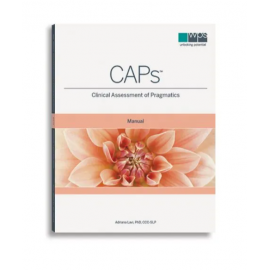

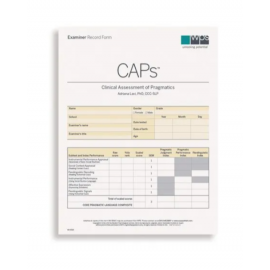
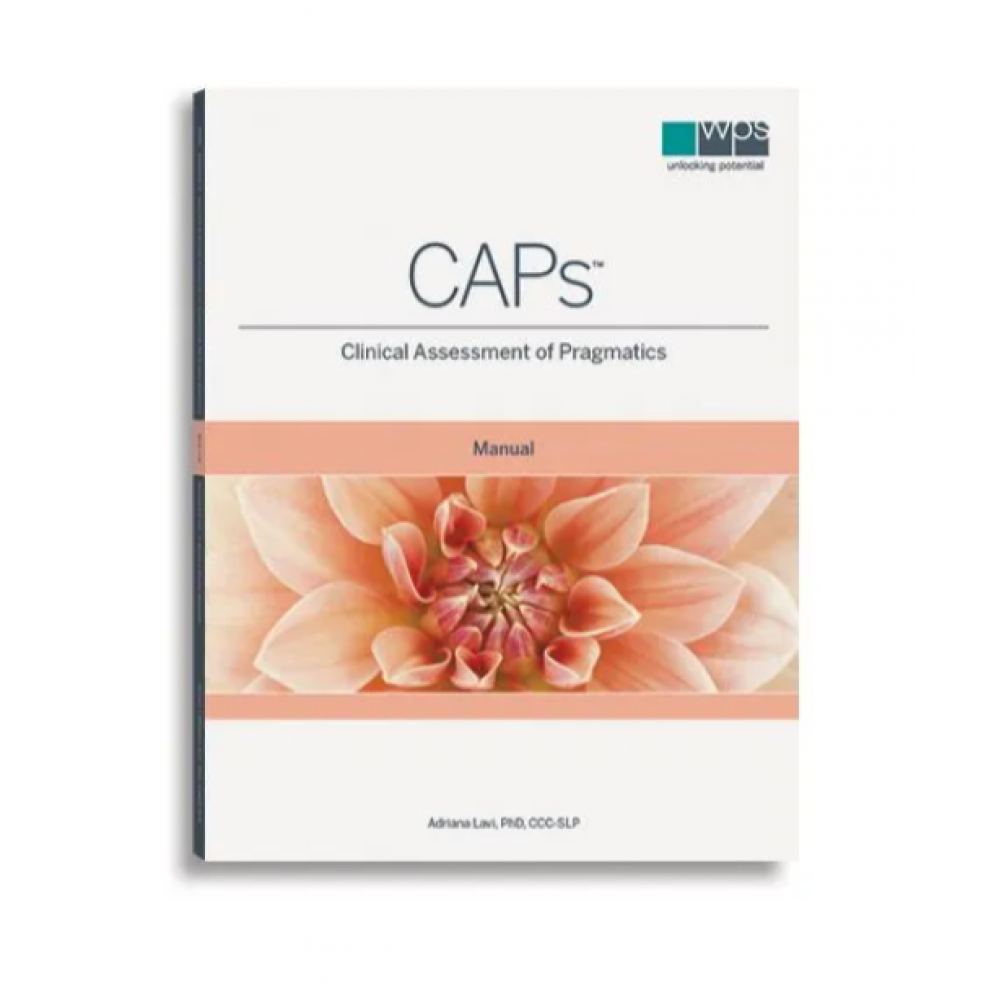
(CAPs) Clinical Assessment of Pragmatics 語用能力臨床評估
Product Description
Benefit
Video based. Provides comprehensive information on pragmatic language skills and social language development of children and young adults
Norms
Based on a sample of 914 children and young adults in the U.S. between the ages of 7 years, 0 months and 18 years, 11 months matching U.S. Census data and stratified within each age group by gender, race/ethnic group, geographic region, and socioeconomic
Scores
Scaled scores and percentiles for each of the 6 tests; standard scores and percentiles for 3 index scores (Pragmatic Judgment, Pragmatic Performance, Paralinguistic) and 1 overall score (Core Pragmatic Language Composite)
Format
Individually administered performance tests based on digital video scenes
Admin Time
45 minutes to 1 hour for all 6 tests
Ages
7 to 18 years
Publish Date
2019
Qualifications
Level C required.
CAPs is a revolutionary assessment that uses video scenes of real people in social situations to assess an examinee’s ability to understand and use pragmatic language, including nonverbal cues, as well as overall dynamics of social context. The videos depict real-life situations, and the examinee responds to questions posed by the examiner after watching each clip. The norm-referenced measure is sensitive to pragmatic deficits exhibited by students with high-functioning autism, language delays, and social (pragmatic) communication disorders.
Range of CAPs uses
The battery of six subtests allows the clinician to obtain a comprehensive profile of pragmatic language skills and social language development. The test helps to:
- Identify pragmatic language deficits and determine the degree of such deficits (e.g., initial IEP-based evaluations)
- Determine strengths and weaknesses within a variety of pragmatic language domains (e.g., pragmatic judgment versus performance, instrumental communication versus affective communication, comprehension and use of paralinguistic cues)
- Document progress in pragmatic language skills, measure treatment efficacy, or re-evaluate overall pragmatic language profiles as part of triennial IEP-based reviews
- Analyze social (pragmatic) language skills in children and young adults for research purposes
Need for Pragmatic Assessment
Speech–language pathologists in schools have limited time for informal pragmatic language evaluations. An increasing number of students are referred for pragmatic language evaluations in schools, but SLPs and school psychologists do not have access to effective and efficient assessment instruments in this area. As a practicing SLP, the author developed this test because of the huge need she witnessed over 15 years.
Video-Based Social Situations
Using a series of video-based social scenarios, examinees are presented with scenes and are asked two types of questions:
- On the pragmatic judgment (receptive pragmatic) subtests, the examinees are asked to judge the appropriateness of a variety of social situations by answering the following: “Did anything go wrong in this video?” and “What went wrong?”
- On the pragmatic performance (expressive pragmatic) subtests, the examinees are presented with a social situation and are asked: “What would you say and how?”
The actors in the videos come from a wide variety of ethnic and cultural backgrounds, and the verbal dialogue is easy to understand. The presentation is controlled for speed without being unnaturally slow. Vocabulary is appropriate to the testing age range, and the real-life situations commonly occur in environments with which the participants could be expected to be familiar.
Standard scores are provided to assess knowledge of:
- Pragmatic judgment (comprehension)
- Performance of pragmatic language (expression)
- Understanding context and emotions (intent of the speaker through inference, sarcasm, and indirect requests)
- Nonverbal cues (facial expressions, prosody, and gestures)
Comprehensive Profile of Pragmatic Language Skills
CAPs evaluates an examinee’s level of pragmatic judgment (meaning their ability to comprehend social situations) and their ability to express themselves in an appropriate manner within various social situations. The pragmatic performance aspect of this test is a unique feature that allows the examiner to elicit the participant’s verbal and nonverbal responses. Beginning with “superficial” layers of social situations, this test delves into every level of pragmatics and assesses “intricate” high-level skills, such as an examinee’s ability to express sadness, gratitude, frustration, support, surprise, and their ability to use nonverbal language.
Assessment of Paralinguistic Skills (Reading and Using Nonverbal Language)
A key area that may have been overlooked by traditional testing is the examinee’s use of higher-level pragmatic language, specifically the ability to use affective communication and paralinguistic cues. The Paralinguistic Decoding subtest assesses the ability to use various nonverbal cues, such as facial expressions, tone of voice, inflections in prosody, gestures, and overall body language to express a variety of communicative intents.
CAPs is an effective means by which speech–language pathologists, as well as other related practitioners, can obtain a comprehensive understanding of their examinees’ pragmatic language needs across social situations.
Efficient Administration and Scoring
The interactive CAPs test can be administered with relative ease. Scoring has been simplified by listing the scoring criteria and rubrics in the Examiner Record Forms. A listing of the most common correct and incorrect responses is provided in the CAPs manual.
Related Search Terms
CAPs, Clinical Assessment of Pragmatics, Social Communication Disorder
CAPs Online
The CAPs is also available on the WPS Online Evaluation System. With the CAPs Online Kit, you get access to the online video and record form, allowing for easier remote administration.
A recent study compared performance on the CAPs using remote administration vs. in-person administration, and the results suggest that test scores obtained through administering the CAPs remotely are equivalent to test scores obtained through standardized, in-person administration.
- 六個分測驗的標準分數與百分等級
- 三個指數分數(語用判斷、語用表現、副語言)及百分等級
- 一個整體分數(核心語用語言綜合指數)
- 辨識語用語言缺陷及其程度(如 IEP 初評)
- 分析不同語用領域的優勢與弱點(如判斷 vs 表現、工具性 vs 情感性溝通、副語言理解與運用)
- 追蹤語用能力進展與治療效果(如三年一次 IEP 重評)
- 用於研究中分析兒童與青少年的語用能力
- 「這段影片有哪裡不對嗎?」
- 「問題出在哪裡?」
- 「你會怎麼說?要怎麼說?」
- 語用判斷(理解能力)
- 語用表現(表達能力)
- 情境與情緒理解(推論、諷刺、間接請求)
- 非語言線索(表情、語調、手勢)
完整語用能力評估
- 理解社交情境的能力(語用判斷)
- 在不同情境中適當表達的能力(語用表現)
- 表達悲傷、感謝、挫折、支持與驚訝
- 使用非語言溝通
- 情感性溝通
- 副語言線索(如表情、語調、語音抑揚、手勢、肢體語言)
- 測驗互動性高,施測簡便
- 計分標準與評分規準已整合於記錄表
- 手冊提供常見正確與錯誤反應範例
- 可進行遠端施測
- 提供影片與記錄表
| W-699 | CAPs Kit 套件 | Email for quotation |
| W-699A | CAPs Examiner Record Form (Pack of 25) 施測記錄表(25份) | Email for quotation |
| W-699M | CAPs Manual 使用手冊 | Email for quotation |
| W-699U | CAPs USB with Audio-Video Scenes CAPs USB(含影音情境) | Email for quotation |
When you order from google.com, you will receive a confirmation email. Once your order is shipped, you will be emailed the tracking information for your order's shipment. You can choose your preferred shipping method on the Order Information page during the checkout process.
The total time it takes to receive your order is shown below:

The total delivery time is calculated from the time your order is placed until the time it is delivered to you. Total delivery time is broken down into processing time and shipping time.
Processing time: The time it takes to prepare your item(s) to ship from our warehouse. This includes preparing your items, performing quality checks, and packing for shipment.
Shipping time: The time for your item(s) to tarvel from our warehouse to your destination.
Shipping from your local warehouse is significantly faster. Some charges may apply.
In addition, the transit time depends on where you're located and where your package comes from. If you want to know more information, please contact the customer service. We will settle your problem as soon as possible. Enjoy shopping!