

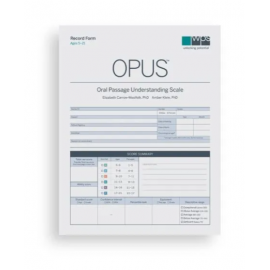


(OPUS) Oral Passage Understanding Scale 口語篇章理解量表
Product Description
Benefit
Assesses listening comprehension, a skill that is essential for classroom learning
Norms
Based on a stratified sample of 1,517 individuals that is representative of the U.S. population in terms of gender, race/ethnicity, parent education level, and geographic region
Scores
Age- and grade-based standard scores and percentiles, test-age and grade equivalents
Format
Individually administered; the examiner reads a passage and related questions aloud from a self-standing easel and the examinee responds orally—no reading or writing required
Admin Time
10 to 20 minutes
Ages
5 to 21 years
Publish Date
2016
Qualifications
Level C required.
Oral Passage Understanding Scale is a new measure of listening (auditory) comprehension. It evaluates a person’s ability to listen to passages that are read aloud and recall information about them. This ability is key to success in the classroom, as well as in social and occupational settings. The OPUS also measures memory skills, which are integral to listening comprehension.
The OPUS shares the same underlying theory as the new Comprehensive Assessment of Spoken Language, Second Edition (CASL-2) and the Oral and Written Language Scales, Second Edition (OWLS-II). Since all three tests are based on the author’s Integrative Language Theory, they provide a cohesive evaluation across a broad range of language areas. While the OWLS-II provides an evaluation of oral and written language abilities, the CASL-2 offers a more in-depth picture of 14 spoken language skills. The new OPUS takes this a step further and tells you how well a person can integrate and apply many of these skills. Although it’s an excellent companion test to the CASL-2, you can also use it on its own anytime you need to quickly measure listening comprehension.
Audio Files
To help show correct pace and tone when administering a test, digital audio recordings of each OPUS passage are provided (see link below). These audio files are for examiner training only and should never be used during administration. OPUS purchase is required for access.
The required password is located on page 5 of the OPUS Manual (W-686M) and the OPUS Online Manual (W-686MP).
Please click here to access the OPUS Audio Files.
Applications and Uses
A versatile instrument, the OPUS can be used by speech–language pathologists and other professionals in a variety of settings, including schools, clinics, hospitals, private practices, and intervention programs When you need to evaluate response to intervention (RTI), you can use the OPUS to track improvement over time. It can also help you answer a variety of referral questions. For example:
- Can a student sufficiently understand and retain information heard in class?
- Are listening difficulties contributing to a child’s social skill challenges?
- Does this college student need someone to take notes in class for him?
The OPUS can be used on its own anytime you need to measure how well an individual understands orally presented information. It provides important evidence for everyone involved in treatment, so you can help children and young adults reach their potential at school, at home, at work, and in the community.
What It Measures
The OPUS is designed to assess the comprehension of spoken language in a natural context, a skill that is fundamental to classroom learning. It evaluates the ability to integrate and apply knowledge in three structural categories of language:
- Lexical/Semantic: Knowledge and use of words and word combinations
- Syntactic: Knowledge and use of grammar
- Supralinguistic: Knowledge and use of language in which meaning is not directly available from the surface lexical and syntactic information
Measuring higher-level comprehension skills, including inference and prediction, yields more detailed information beyond simply whether or not the individual can comprehend. These skills require deeper processing abilities and thus differentiate typically developing individuals from those with language and learning delays or disorders.
The OPUS also measures memory skills, which are integral to listening comprehension. While the CASL-2 attempts to remove memory as much as possible in order to isolate the specific skill being tested, the OPUS includes memory because it’s an important part of listening comprehension in everyday life.
How It Works
The OPUS consists of 17 passages, each with 7 to 10 associated questions. These passages are divided into six Item Sets to allow for a brief administration time of just 10 to 20 minutes. Each Item Set has 5 passages and up to 44 items. Selecting the appropriate Item Set, based on the examinee’s age and ability, ensure that developmentally appropriate items are administered. Please see the table (below) for a visual representation of the overlapping Item Sets and passages.
Item Set A
Ages: 5 to 6
Passages: 1 to 5
Item Set B
Ages: 7 to 8
Passages: 4 to 8
Item Set C
Ages: 9 to 10
Passages: 7 to 11
Item Set D
Ages: 11 to 13
Passages: 9 to 13
Item Set E
Ages: 14 to 16
Passages: 11 to 15
Item Set F
Ages: 17 to 21
Passages: 13 to 17
- 標準分數
- 百分等級
- 年齡等值
- 年級等值
- OWLS-II:口語與書寫語言能力
- CASL-2:14 項口語語言技能
- OPUS:評估整合與應用語言能力的能力
- 學校
- 診所
- 醫院
- 私人執業
- 介入方案
- 學生是否能理解課堂內容?
- 聽力問題是否影響社交能力?
- 是否需要學習輔助(如筆記支援)?
- 評估介入成效(RTI)
- 追蹤進步
- 推論能力
- 預測能力
- 17 篇文章
- 每篇 7–10 題
- A:5–6 歲
- B:7–8 歲
- C:9–10 歲
- D:11–13 歲
- E:14–16 歲
- F:17–21 歲
- 記錄表
- 展示冊(Easel)
- 使用手冊
- 訓練音檔(僅供施測者訓練)
- 題項分析(找出優勢與弱點)
- IEP 與介入計畫支持
- 可即時或事後評分
- 計算總原始分數
- 轉換為標準分數
免費線上計分與報告
- 自動產生報告
- 進度追蹤
- 資料安全儲存(符合 HIPAA)
- 標準化樣本:1,517 人(5–21 歲)
- 與 CASL-2 共用常模
- 可區分多種語言與發展障礙:
- 語言障礙
- 聽力障礙
- ASD
- 學習障礙等
- 內部一致性
- 重測信度
- 評分者一致性
| W-686 | OPUS Kit 套件 | Email for quotation 電郵詢價 |
| W-686A | OPUS Form (Pack of 10) 記錄表(10份) | Email for quotation 電郵詢價 |
| W-686B | OPUS Easel 展示冊 | Email for quotation 電郵詢價 |
| W-686BP | OPUS Digital Easel 數位展示冊 | Email for quotation 電郵詢價 |
| W-686M | OPUS Manual 使用手冊 | Email for quotation 電郵詢價 |
When you order from google.com, you will receive a confirmation email. Once your order is shipped, you will be emailed the tracking information for your order's shipment. You can choose your preferred shipping method on the Order Information page during the checkout process.
The total time it takes to receive your order is shown below:

The total delivery time is calculated from the time your order is placed until the time it is delivered to you. Total delivery time is broken down into processing time and shipping time.
Processing time: The time it takes to prepare your item(s) to ship from our warehouse. This includes preparing your items, performing quality checks, and packing for shipment.
Shipping time: The time for your item(s) to tarvel from our warehouse to your destination.
Shipping from your local warehouse is significantly faster. Some charges may apply.
In addition, the transit time depends on where you're located and where your package comes from. If you want to know more information, please contact the customer service. We will settle your problem as soon as possible. Enjoy shopping!