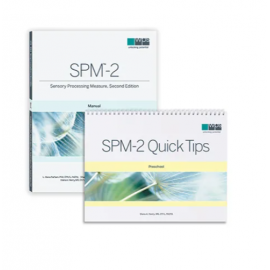
Provides a complete picture of sensory integration and processing difficulties in multiple environments; SPM-2 Quick Tips offer item level intervention strategies to help with sensory integration and processing challenges
Based on 3,850 typically developing participants, ranging in age from 4 months to 87 years
20 to 30 minutes for each of the 12 main forms; 10 minutes for each Environment Form
Level C required.
SPM-2™: Expanded Across the Lifespan for Research, Clinical, and School-Based Practice
You can’t see sensory processing deficits just by looking at someone, but their needs will become clearer when you use the new SPM-2.
The SPM-2 is an upgrade and expansion of the Sensory Processing Measure family of products, widely acclaimed as the best of its kind. A behavior rating scale, the SPM-2 offers new forms – including driving forms – and a broadened age range, so no one gets left behind.
Like its predecessors, the new SPM-2 is firmly grounded in Ayres Sensory Integration® theory. T‑scores provide norm-referenced indexes of the integrative functions of praxis and social participation, as well as the following sensory systems:
- Visual
- Auditory
- Tactile
- Olfactory and Gustatory (new)
- Proprioceptive
- Vestibular
The SPM‑2 items provide descriptive clinical information on processing vulnerabilities within each sensory system, including under- and over-reactivity, sensory-seeking behavior, and difficulties with perception.
The forms at each age level are designed for maximum flexibility in choosing and comparing among environments and raters, such as multiple caregivers.
What’s new in the SPM-2
The SPM-2 is a revision and update of the Sensory Processing Measure and Sensory Processing Measure–Preschool, two well-established instruments in wide use throughout the world. While the essential characteristics of the SPM and SPM-P remain unchanged, the SPM-2 revision includes the following improvements:
- An expanded age range that encompasses the lifespan, from 4 months to 87 years
- New and revised forms across five age levels: Infant/Toddler, Preschool, Child, Adolescent, and Adult
- Updated norms based on a new, nationally representative standardization sample
- Ability to compare sensory integration and processing function between individuals
- New clinical validity studies, including sensory processing disorders, autism spectrum disorders, speech–language pathologies, intellectual and developmental disorders, attention-deficit/hyperactivity disorder, and other mental health disorders
- Updated SPM-2 Quick Tips now included in every Preschool and Child kit
- Print or online administration
The SPM-2 may be administered using printed forms or electronically through the WPS® Online Evaluation System™ (OES), the WPS online testing platform, which allows administration of the SPM-2 on any computer with Internet access. Raters may complete the SPM-2 form remotely or on the professional’s local device. When administered to the same rater multiple times, the form can be scored and integrated into a Progress Monitoring Report. Multiple forms on the same client can be scored and integrated into a combined report. For more information, visit our online platform.
Multiple raters, integrated assessment
The SPM-2 is designed to assess clients across the life span, with unique forms in each of five age levels: Infant/Toddler, Preschool, Child, Adolescent, and Adult. At each level, forms may be used independently or jointly to provide an overview of a client’s sensory functioning across multiple environments and raters.
The 12 main forms each consist of 80 Likert-type items rated in terms of the frequency of a specific behavior (Never,Occasionally, Frequently, Always) and require about 20 to 30 minutes to complete. The 10 School Environment and Driving Environment Forms are 15 to 18 items each and take about 10 minutes to complete. The following SPM-2 forms are listed by age level:
Infant/Toddler (4 to 30 months)
Parents and caregivers rate an infant or toddler and also rate themselves on their own sensory integration and processing function in areas related to caregiving for an infant or toddler.
- Infant Form: Ages 4-9 months
- Toddler Form: Ages 10-30 months
- Caregiver Self‑Report Form: Ages 4-30 months
- Preschool (2 to 5 years)
Parents, caregivers, and school providers rate a preschool-aged child within the home and school environments.
- Home Form
- School Form
Child (5 to 12 years)
Parents, caregivers, and school staff rate a school-aged child within the home and school environments.
- Home Form
- School Form
- School Environment Forms
- Art (ART) Form
- School Bus (BUS) Form
- Cafeteria (CAF) Form
- Music (MUS) Form
- Physical Education (PHY) Form
- Recess/Playground (REC) Form
Adolescent (12 to 21 years)
Adolescents rate themselves, and parents, caregivers, and school staff rate the adolescent within the home and school environments.
- Home Form
- School Form
- Self‑Report Form
- Adolescent Driving Environment Forms
Adult (21 to 87 years)
Adults rate themselves, and spouses, partners, parents, other adult family members, or caregivers rate the adult within the home and community environments.
- Rater Report Form
- Self‑Report Form
- Adult Driving Environment Forms
The SPM‑2 forms are intended to be used together as an integrated system to provide a comprehensive overview of a client’s sensory integration and processing across home, school, caregiving, and community settings. As such, multiple forms may be used within each age level. However, each form may also be used separately.
Comprehensive and easy to understand
The SPM-2 provides information in a way that parents find useful. Scale names remain comprehensible, results are summarized visually, and interpretation is clear-cut. These features help therapists explain assessment results and engage parents in the treatment process.
The main forms include each of the following scales:
- Vision
- Hearing
- Touch
- Taste and Smell
- Body Awareness
- Balance and Motion
- Sensory Total
- Planning and Ideas
- Social Participation
SPM-2 Scores
SPM‑2 items employ a rating scale based on how frequently behaviors occur.
SPM‑2 raw scores for each of these scales are converted into normalized T‑scores, a type of standard score, which have a mean of 50 and a standard deviation of 10. A standard score enables an individual’s test results to be compared with a reference group, such as a normative sample of typically developing individuals. A standard score also allows for comparison of scores across scales with different characteristics, such as different numbers of items, different psychometric properties, or different constructs.
SPM‑2 T-scores are used in conjunction with an analysis of item responses to develop an interpretation of a client’s functioning.
SPM‑2 T-scores are also used to calculate the Difference (DIF) score, which allows clinicians to compare sensory functioning across any two forms. A DIF score can reveal, for example, whether a child’s behavior at home is markedly different from their behavior at school, or whether an adolescent’s self-perception is substantially different from a teacher or parent’s perceptions. It can also provide a starting point for examining sensory integration and processing differences between individuals; for example, between two spouses or a parent and child.
Psychometrically strong
The SPM‑2 was standardized on 3,850 typically developing participants, ranging in age from 4 months to 87 years. Separate demographically representative normative samples were collected for each age level: Infant/Toddler (N = 697), Preschool (N = 606), Child (N = 840), Adolescent (N = 985), and Adult (N = 722). Separate norms are provided for each age level, and within two age levels (Infant/Toddler and Preschool), the norms are further stratified by age to control for developmental differences between the younger and older children. A separate sample of 639 participants receiving clinical services was used to verify that the SPM‑2 differentiates between typically developing participants and those with certain clinical disorders.
Across all forms, the SPM‑2 showed strong psychometric properties. Evidence supporting reliability included median estimates of internal consistency of .86, test–retest reliability of .84, alternate-forms reliability of .78, and interrater reliability of .66. Likewise, comprehensive development procedures, concurrent administration of key measures, and findings from clinical groups yielded evidence supporting content validity, construct validity, and criterion-related validity.
Use with confidence
The SPM‑2 forms perform well on seven key indexes of reliability: internal consistency, test–retest reliability, standard error of measurement, interrater reliability, alternate-forms reliability, cross-rater concordance, and digital and paper forms equivalence. Analyses of content and structure support the scoring of separate sensory systems, praxis, and social participation scores across the SPM‑2 forms. The SPM‑2 forms correlate in expected ways with two measures of sensory integration and processing, the Sensory Profile and the Sensory Profile 2, and a measure of adaptive behavior, the ABAS‑3. Finally, the SPM‑2 forms distinguish between typically developing and clinic-referred clients, with robust and clinically meaningful effect sizes.
Principles of use
The SPM‑2 is intended to support the identification and treatment of those with sensory integration and processing difficulties. The SPM‑2 was developed by occupational therapists, but the information it provides will also be of value to other professionals, including school psychologists, clinical psychologists, social workers, counselors, physical therapists, speech–language pathologists, early intervention specialists, psychiatrists, pediatricians, and nurses.
The SPM‑2 may be used alone as a screening instrument or in conjunction with other instruments as part of a comprehensive battery. Like any instrument, however, the SPM‑2 should never be used in isolation to make diagnostic or treatment decisions. Instead, it should be used in concert with other data, such as information derived from concurrent or former assessments of sensorimotor function; additional standardized assessment instruments; developmental, school, work, or medical records; occupational profiles; direct observations; and interviews with parents, teachers, school staff members, and (when appropriate) the client.
Intervention: SPM-2 Quick Tips
After administering the SPM-2, the assessment will guide you to appropriate intervention strategies in the SPM-2 Quick Tips, which are currently available at the Preschool and Child age levels.
The SPM‑2 Quick Tips are simple, straightforward suggestions, tasks, and activities connected to each SPM‑2 item, designed to help clients manage, minimize, or cope with sensory integration and processing challenges. The SPM‑2 Quick Tips make use of Ayres Sensory Integration principles and specific sensory techniques and are meant to be implemented by various people involved in a client’s care, including parents, day care providers, teachers or other school personnel, early intervention providers, adult caregivers, occupational therapy practitioners, and mental health experts.
Every SPM‑2 Quick Tips suggestion is designed to further one of the seven objectives listed below. Using clinical reasoning, the practitioner and team choose or develop strategies that most closely align with one or more of these objectives:
- Improve sensorimotor functions
- Educate to support functioning
- Promote self-advocacy and empowerment
- Develop adaptations and accommodations
- Use cognitive or behavioral strategies
- Teach new skills, including self-regulation
- Address the sensory integration and sensory processing patterns of others
Like the SPM-2, the Quick Tips are available in print or online, allowing you to measure qualitative and quantitative progress. The online module on the OES allows you to quickly create customized intervention reports that can be easily shared via email or printed paper.
You can choose and track the frequency of use of each strategy within their own environment using the SPM-2 Quick Tips Record Form, available in printed version and online. The SPM-2 Quick Tips Record Form, which automatically calculates the weekly and monthly totals, can be used for research and to monitor progress.
(SPM™-2)感覺處理量表 第二版(含 Quick Tips 介入建議)
優點(Benefit)
提供多環境下感覺統合與處理困難的完整評估;SPM-2 Quick Tips 提供逐題介入策略,協助改善感覺處理問題
常模(Norms)
基於 3,850 名一般發展者(4 個月至 87 歲)建立
語言版本(Translation)
西班牙文
分數(Scores)
原始分數、標準分數(T 分數)、百分等級、差異分數(DIF)
形式(Format)
由受測者生活中的不同評量者填寫的評分量表
施測時間(Admin Time)
每份主要量表 20–30 分鐘;每份環境量表約 10 分鐘
適用年齡(Ages)
4 個月至 87 歲
出版年份(Publish Date)
2021
使用資格(Qualifications)
Level C
概述
SPM-2 是感覺處理量表系列的升級與擴展版本,廣泛被認為是同類工具中最優秀之一。此新版涵蓋整個生命週期,並新增多種量表(包含駕駛情境),讓各年齡層皆可評估。
SPM-2 以 Ayres 感覺統合理論為基礎,透過 T 分數提供以下功能的常模指標:
- 動作計畫(Praxis)
- 社會參與(Social Participation)
- 感覺系統:
同時提供臨床描述資訊,例如:
SPM-2 的更新重點
- 年齡範圍擴展至 4 個月至 87 歲
- 五個年齡層全新/修訂量表:
- 更新常模(全國代表性樣本)
- 可比較不同個體的感覺功能
- 新臨床效度研究(自閉症、ADHD、語言障礙等)
- Quick Tips 介入建議(學齡前與兒童版本)
- 支援紙本與線上施測
多評量者整合評估
SPM-2 設計用於跨環境與跨評量者評估:
嬰幼兒(4–30 個月)
學齡前(2–5 歲)
兒童(5–12 歲)
- 家庭量表
- 學校量表
- 學校環境量表(美術、校車、餐廳、音樂、體育、操場)
青少年(12–21 歲)
成人(21–87 歲)
測驗結構
- 12 份主要量表:
- 每份 80 題(李克特量表:從「從不」到「總是」)
- 10 份環境/駕駛量表:
評量指標(主要量表)
- 視覺
- 聽覺
- 觸覺
- 味覺與嗅覺
- 身體覺察(本體覺)
- 平衡與動作(前庭覺)
- 感覺總分
- 計畫與想法(Praxis)
- 社會參與
分數解釋
- T 分數(平均 = 50,標準差 = 10)
- 可與常模比較
- 可跨量表比較
DIF 差異分數
用於比較不同評量表之間的差異,例如:
心理計量特性
- 樣本數:3,850 人
- 信度:
- 內部一致性:.86
- 重測信度:.84
- 形式間信度:.78
- 評量者間信度:.66
能有效區分:
使用原則
SPM-2 可用於:
不應單獨用於診斷決策,應搭配:
SPM-2 Quick Tips(介入建議)
SPM-2 評估後可搭配 Quick Tips 使用:
提供每題對應的實用策略,例如:
適用對象包括:
七大介入目標:
- 改善感覺動作功能
- 提供教育與支持
- 增強自我倡議能力
- 發展環境調整
- 使用認知/行為策略
- 教導新技能(如自我調節)
- 處理他人感覺互動
可追蹤使用頻率與進展(週/月)